FBI Senior Computer Scientist David Loveall II’s rebuttal report — defective at the basic level.
A point-by-point breakdown of the DOJ’s sole forensic rebuttal to the seven-expert findings of evidence fabrication and planting — the report Judge Garaufis relied on to deny an evidentiary hearing.
-
Who Loveall is.
FBI Senior Computer Scientist out of Quantico. Recipient of the Presidential Early Career Award for Scientists and Engineers for his contributions to digital forensics, the FBI Director’s Award for Outstanding Technical Advancement, and the Intelligence Community Seal Medallion.
He is not a forensic examiner routinely assigned to prosecutions. Over a four-year span, the only other case in which Loveall was brought in for testimonial evidence was Jack Smith’s Mar-a-Lago prosecution of President Trump.
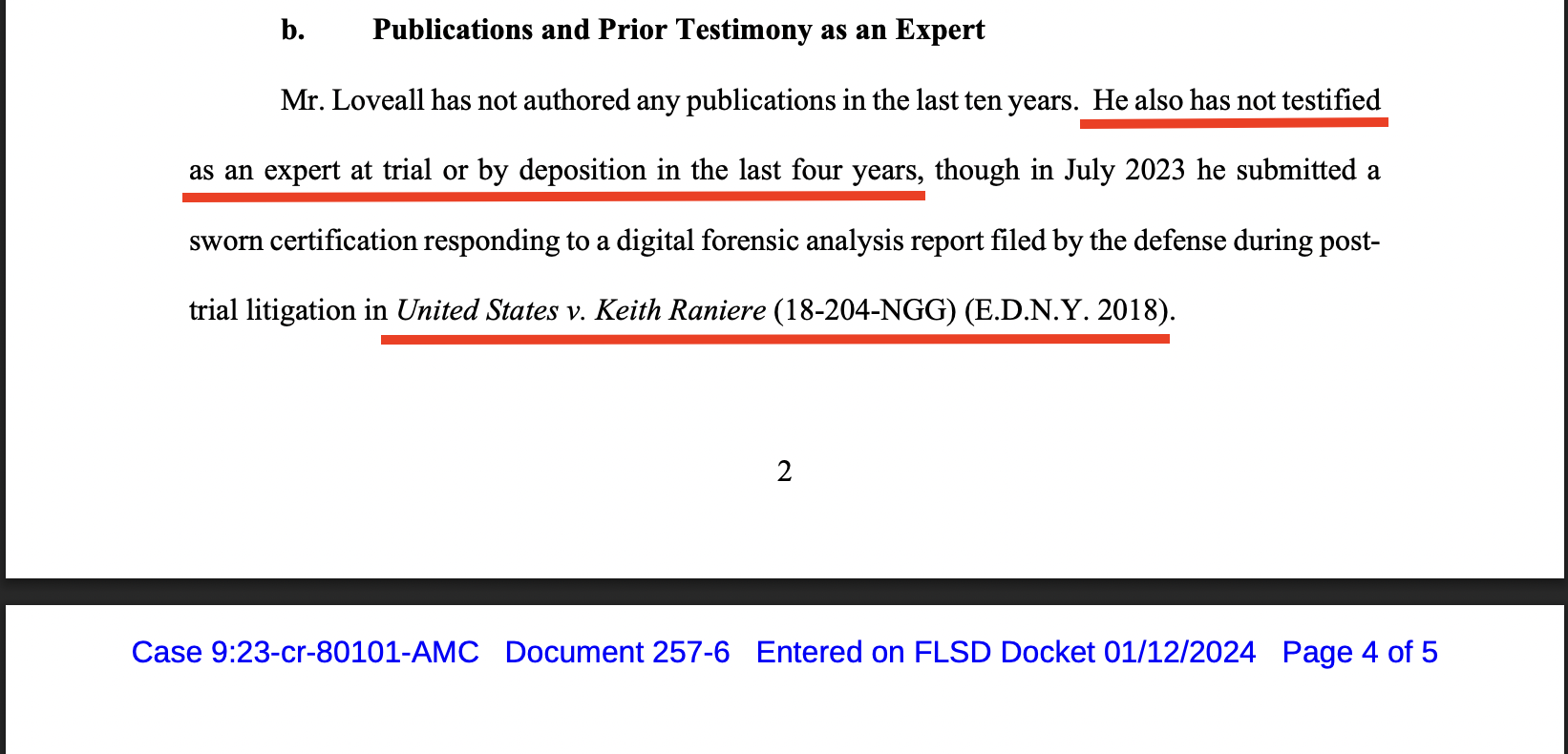
Jack Smith expert notice, Doc. 257-6. Loveall designated as testifying forensic expert in the Mar-a-Lago prosecution. View the source PDF → -
The DOJ brought him in to rebut the seven post-conviction experts.
On July 21, 2023, the DOJ brought Loveall in to respond to the findings of seven post-conviction experts (four former FBI examiners) that the camera’s memory card and an external hard drive had been falsified. Loveall produced a report denying the findings.
-
The report contained no proof.
Under Federal Rule of Evidence 702, expert testimony must be based on sufficient facts or data. Loveall’s rebuttals contain technical language but no proof — only hypotheticals presented as findings. His own diagrams are illustrations he created, not proof.
A forensic report without underlying proof is not admissible expert opinion — it is assertion.
-
Loveall’s rebuttal to the “37 additional files” finding — defects on display.
The seven experts found that 37 files appeared on a second, undisclosed forensic copy of the memory card — indicating either planting in FBI custody between the first and second copy, or omission from the first copy’s report. They concluded at least 28 of those files had been tampered with and at least 20 had been planted.
Loveall’s full rebuttal:
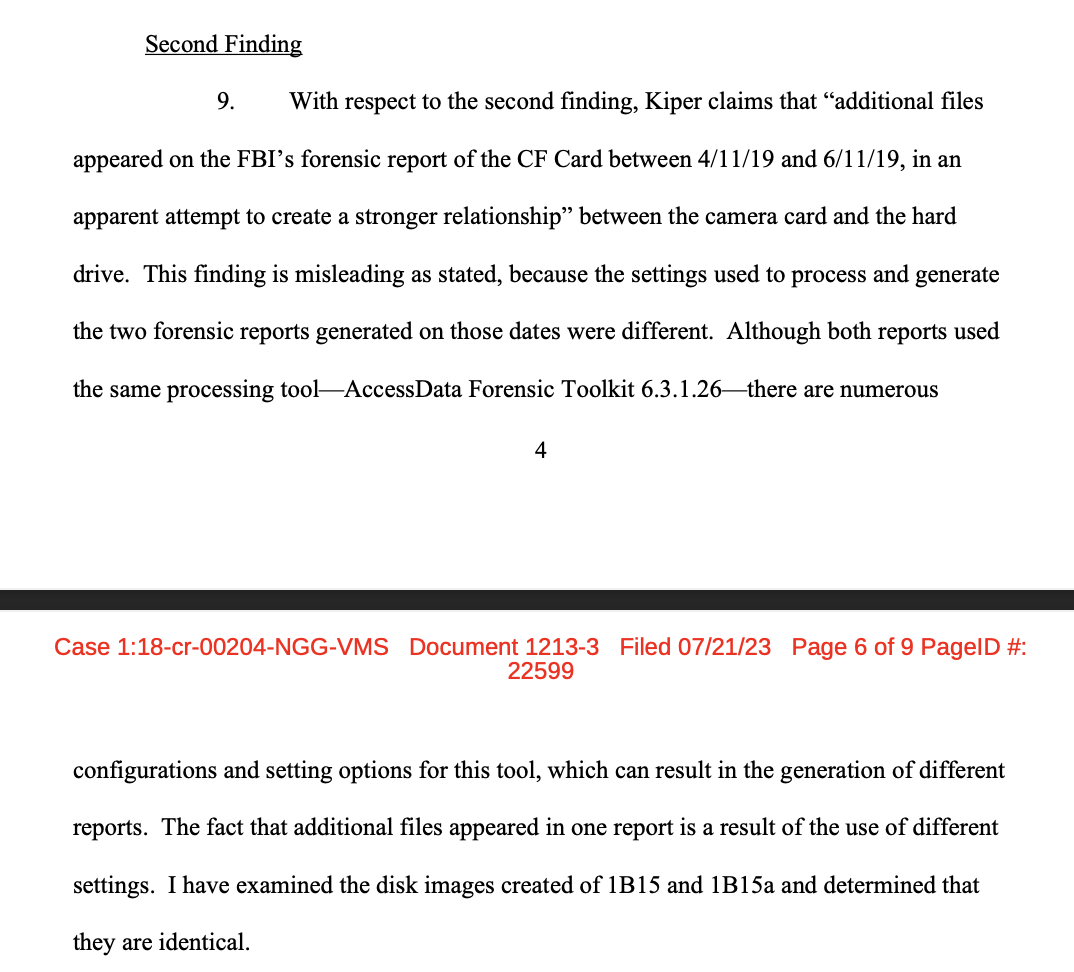
Loveall report, Doc. 1213-3, pp. 4–5. But wait — three major problems with this short paragraph:
- He says the “additional files” came from “different settings” in the reporting software — but doesn’t specify which settings, or provide any proof.
- He says he determined the disk images are “identical” — but how? What test? Where’s the proof? The standard check here is simple: a hash value (digital fingerprint) — the exact test Jack Smith called him to testify about in the Mar-a-Lago case. He provided no hash values here.
- He identifies the evidence as “1B15 and 1B15a” — but those are the wrong items. 1B15 is the camera. 1B15a is the camera’s memory card. Saying a copy of the camera is “identical” to a copy of the memory card is as nonsensical as saying a copy of a DVD player is identical to the DVD inside it.
-
The FBI’s own examiner testified at trial about the hash standard.
The government’s own examiner, Brian Booth, testified that the FBI uses hash verification on every case: “Message Digest 5, called the MD5 verification” — if “anything gets changed on a hard drive… this whole function… would be different and we know something has been changed.”
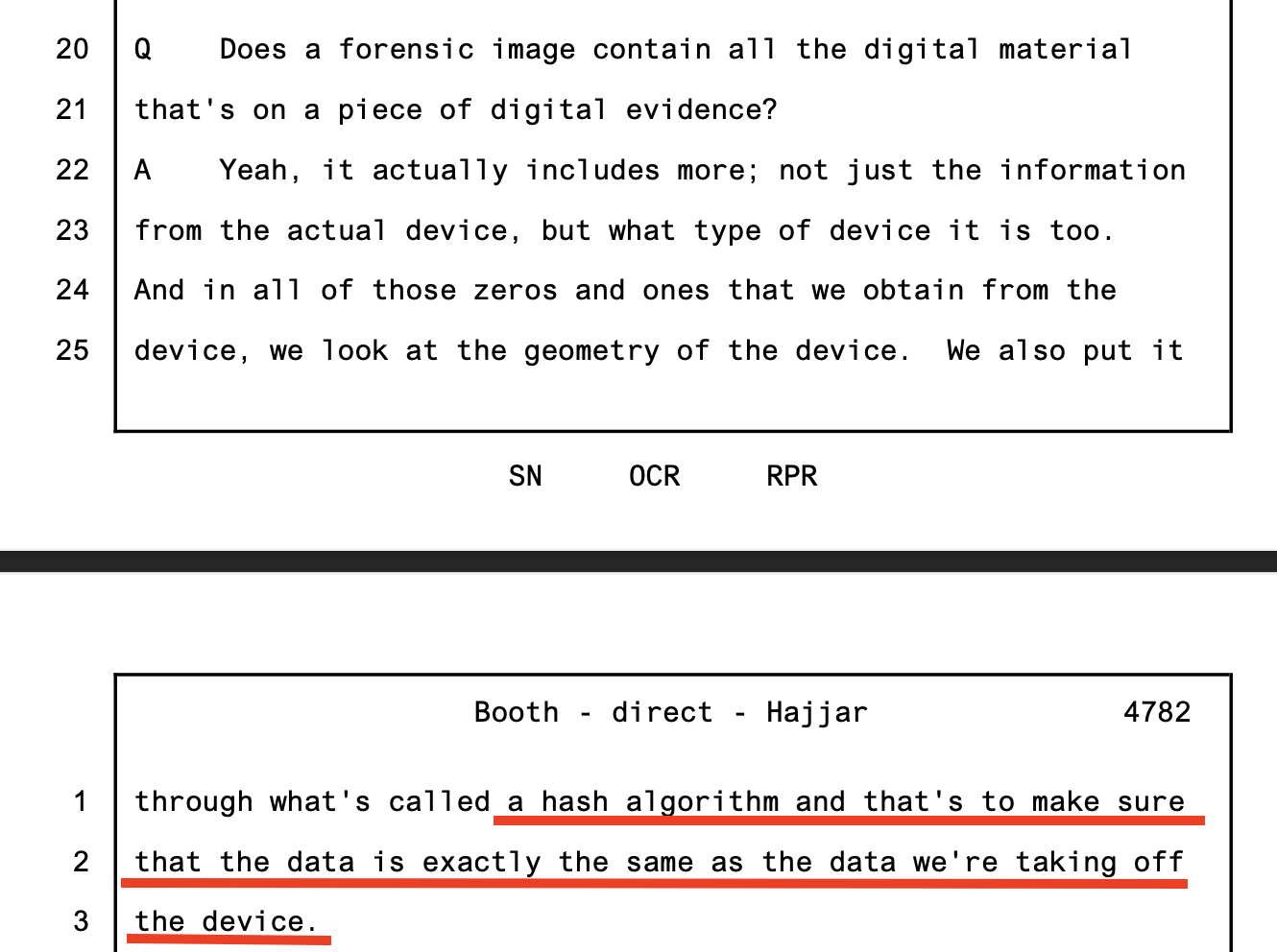
Booth Tr. p. 4782. Click to enlarge. 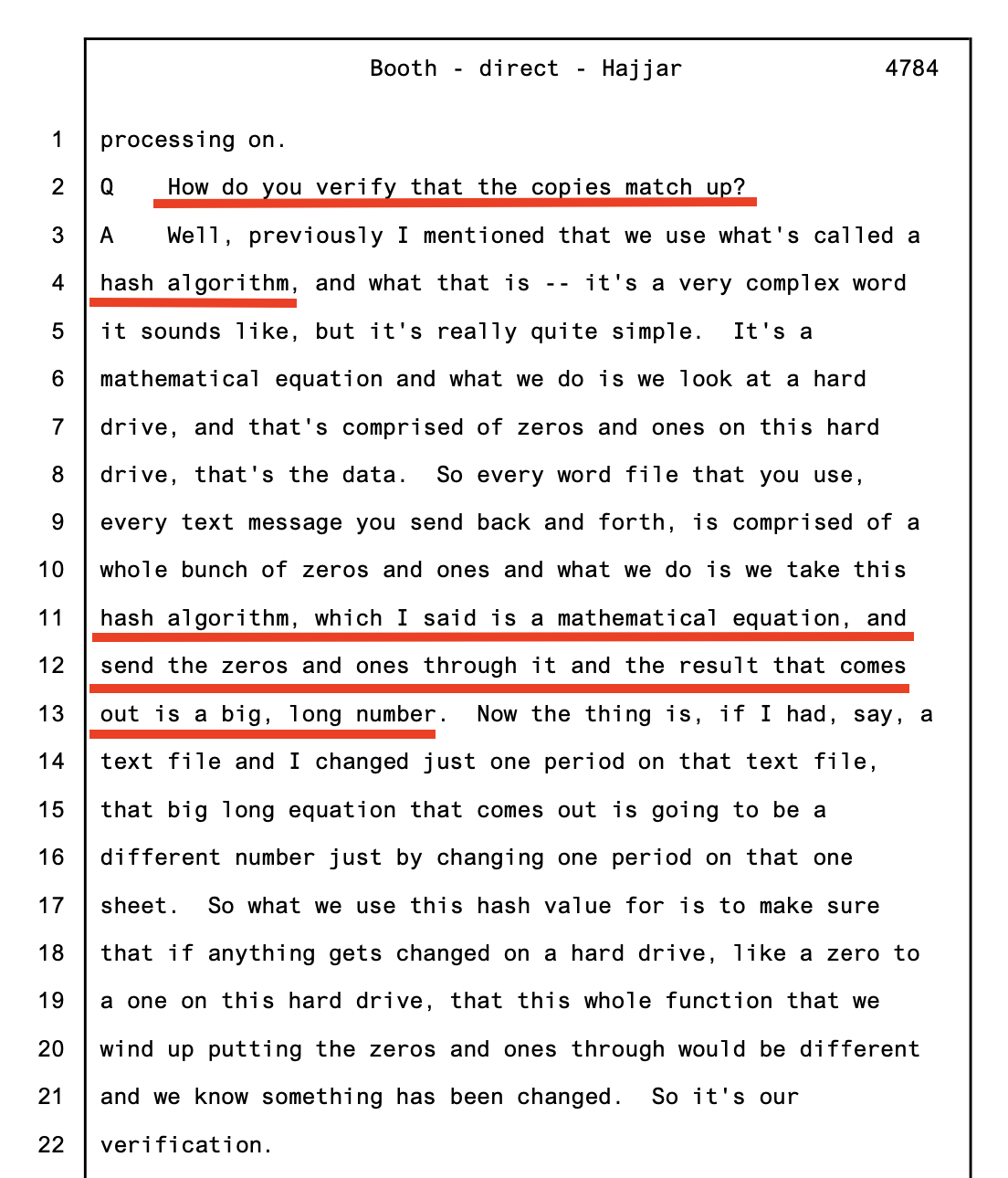
Booth Tr. pp. 4784–4785. Click to enlarge. -
The report contains no date.
Not on the cover. Not in the body. Not anywhere. 28 U.S.C. § 1746 requires a date to legally bind a declarant to the penalty of perjury. Without a date, the declaration has no legal force — the expert is not bound by his own findings.
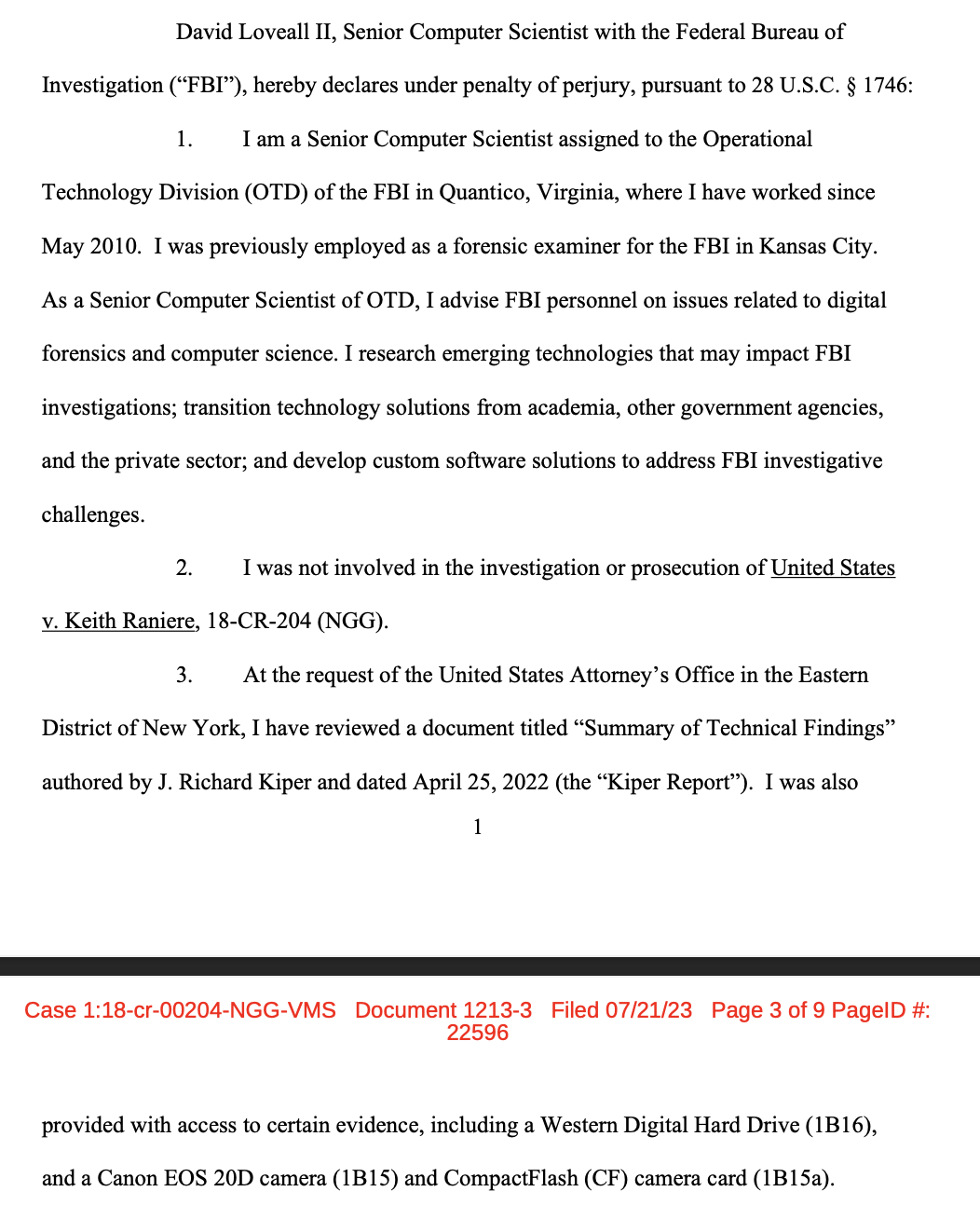
Loveall report — opening. No date on the cover. The comparison Kiper report, submitted in the same filing, is dated. 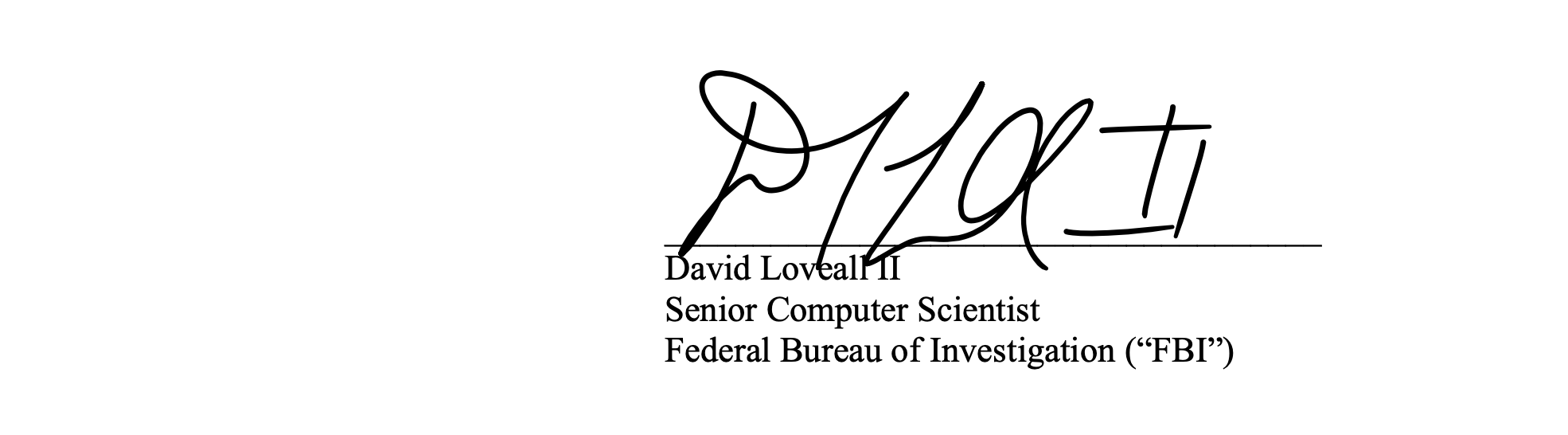
Loveall report — signature page. No date. -
The prosecutor accepted it — and never asked Loveall to date it.
AUSA Tanya Hajjar had been working on her response to the defense for over a year before submitting it (Doc. 1213) on July 21, 2023. The other witness declaration she attached to that same motion was signed on June 6, 2022 — thirteen months earlier — and that declaration had a date.
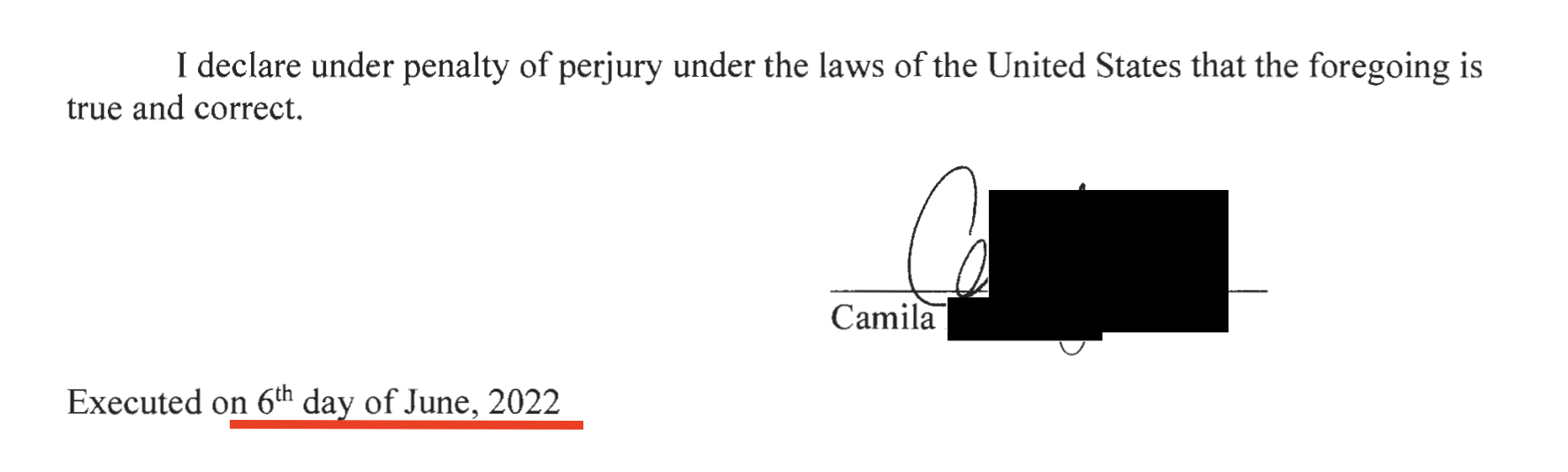
Other declaration in the same motion — dated June 6, 2022, thirteen months before Hajjar filed the motion. Across the same brief, Hajjar quoted Loveall’s findings directly and cited his declaration repeatedly — at least six citation instances and three direct quotations visible in the excerpts below. The Loveall declaration was the centerpiece of her forensic rebuttal — yet she never asked Loveall to date it.
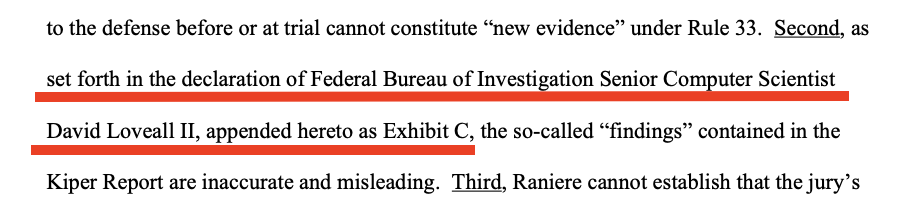
Hajjar motion, Doc. 1213 — introducing the Loveall declaration as Exhibit C. 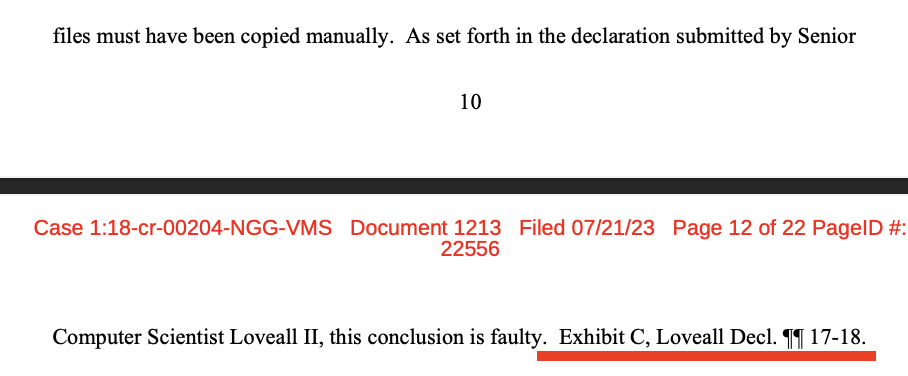
Hajjar motion, Doc. 1213 at p. 12 — citation to Loveall Decl. ¶¶ 17–18. 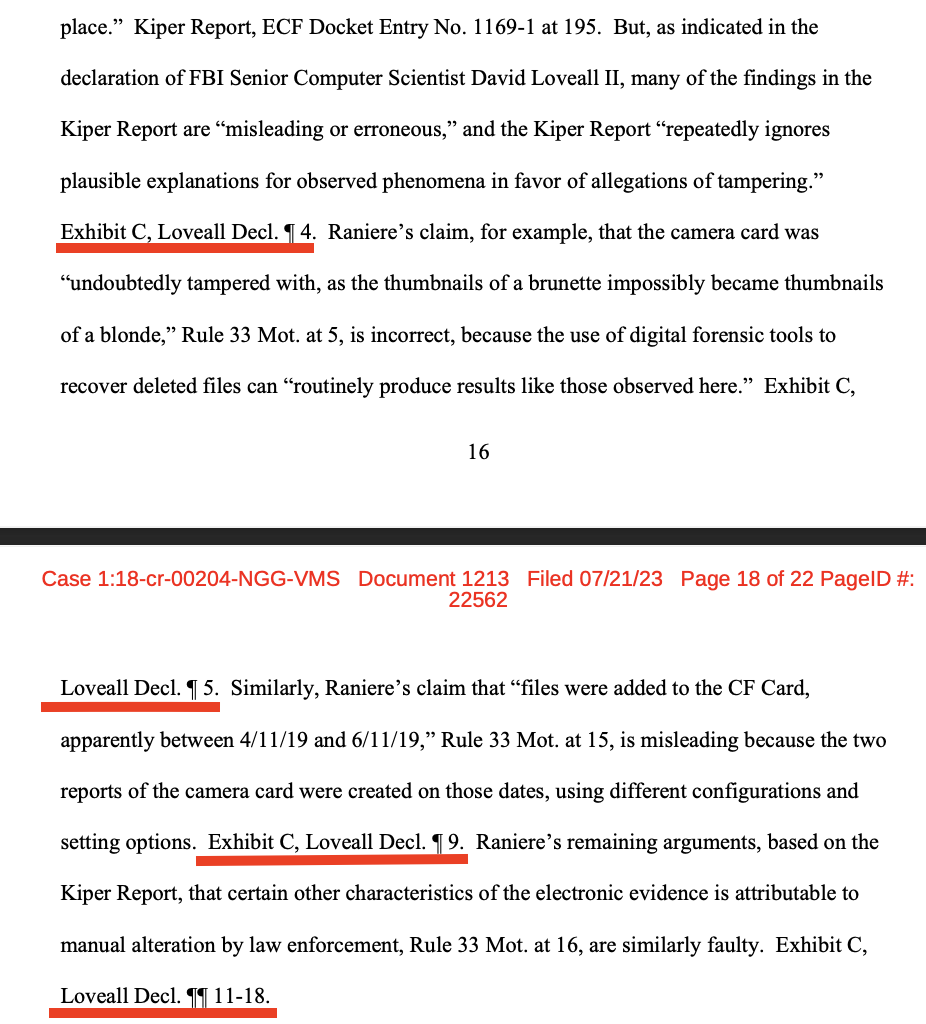
Hajjar motion, Doc. 1213 at pp. 17–18 — direct quotations from Loveall (“misleading or erroneous,” “repeatedly ignores plausible explanations … in favor of allegations of tampering,” “routinely produce results like those observed here”) and citations to Loveall Decl. ¶ 4, ¶ 5, and ¶¶ 11–18. Is it possible that AUSA Tanya Hajjar obtained the Loveall report, quoted from it multiple times, and relied on it as her sole forensic rebuttal to the unanimous conclusions of seven experts — four former FBI — that government agents were involved in evidence falsification, in the most high-profile case of her career, and did not realize it was undated?
-
The only testing the report claims was on a computer model that does not exist.
Loveall’s only claimed independent testing was on “a Dell Dimension 8300-20090330” — a computer he says he procured to test the opposing expert’s claim. No such Dell model exists. The “20090330” suffix is a date code (March 30, 2009) lifted from a folder name in the case evidence — not part of any real Dell hardware identifier. Either the testing never happened, or the report’s most basic factual claim about its own methodology cannot be verified.

Loveall report excerpt. The cited Dell Dimension model does not exist. -
Two independent debunkings.
- Joint Expert Debunking of the Loveall Report (Doc. 1273-7) — seven post-conviction forensic experts (four former FBI), point-by-point.
- Retired FBI ASAC Mark Bowling’s analysis — concluded the report was “structured to be intentionally deceptive.”
Did FBI Senior Computer Scientist David Loveall — recipient of the Presidential Early Career Award for Scientists and Engineers, the FBI Director’s Award for Outstanding Technical Advancement, and the same expert Jack Smith selected to explain hash values to a jury in the prosecution of President Trump — not know that his report contained no proof, no date, and a claim of testing on a Dell model that does not exist?
- Loveall report, Doc. 1213-3 (PDF) — undated
- Hajjar opposition motion, Doc. 1213 (PDF) — the full 22-page brief in which Hajjar quoted and cited the undated Loveall declaration
- Jack Smith expert notice, Doc. 257-6 (PDF) — Loveall designated as testifying expert in Mar-a-Lago prosecution
- Joint Expert Debunking of the Loveall Report (Doc. 1273-7)
- Bowling Analysis of the Loveall Report — “structured to be intentionally deceptive”
- Booth trial testimony — FBI MD5 hash verification standard