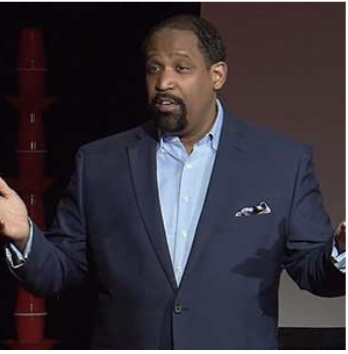
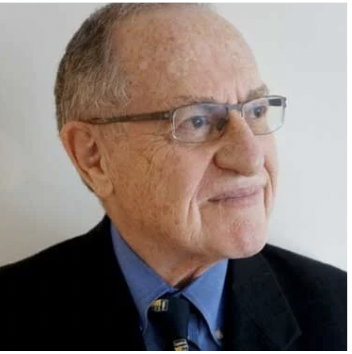
“In our collective experience, we have never seen a case with this degree of widespread government malfeasance as United States v. Keith Raniere et. al.”
— Signed by three former U.S. Attorneys:
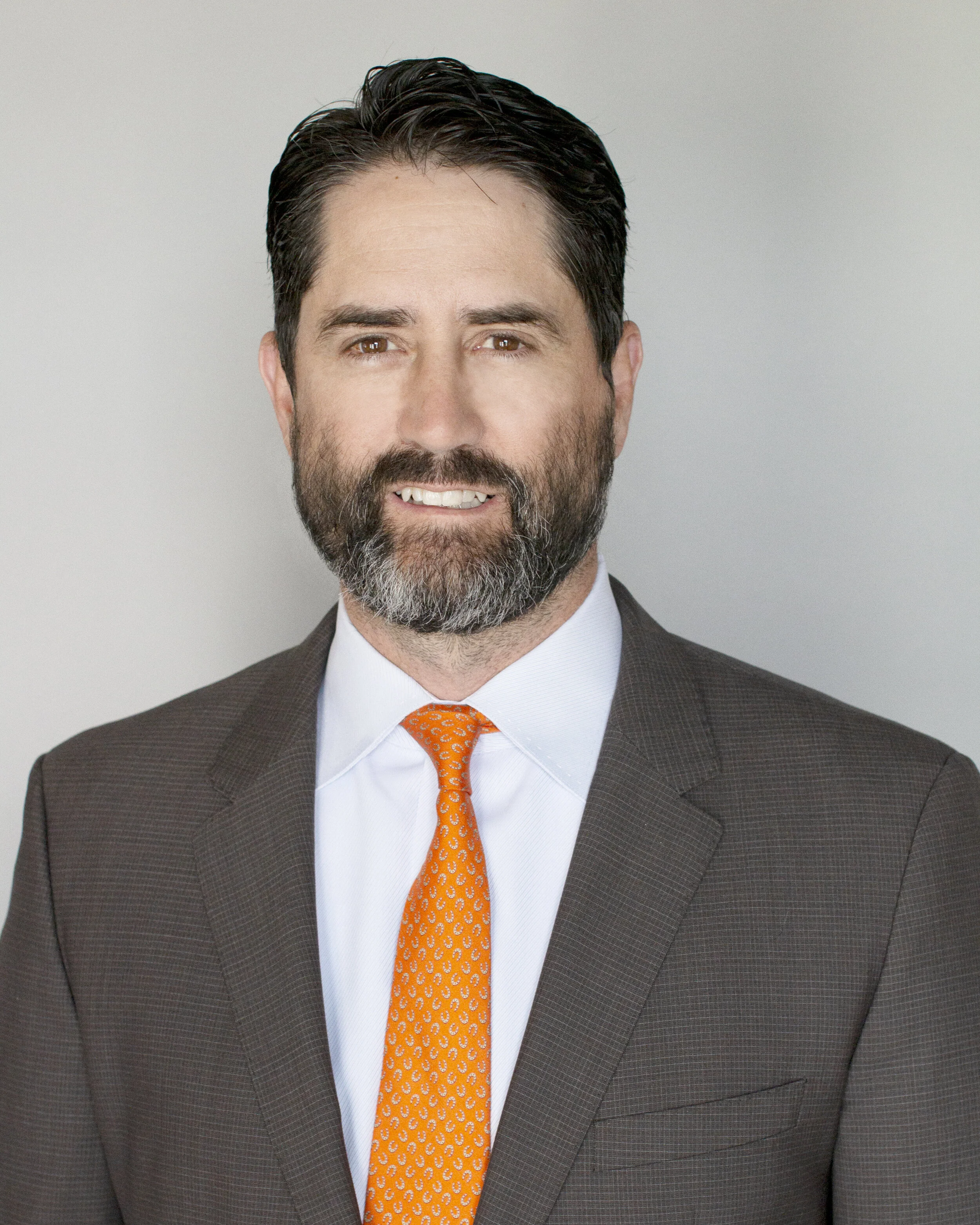
& other prominent individuals
Seven forensic experts — including four former FBI examiners — concluded under oath that the evidence the prosecution called the “heart” of its case was planted on a hard drive and camera’s memory card, with falsified timestamps. An independent Newsweek expert verified their findings.
You can verify for yourself using the government’s own records that misconduct pervaded the entire case:
-
Feb–Mar 2018 — Prosecutors leaked sealed charges to Mexico — bypassing the extradition process.
- On February 14, 2018, EDNY prosecutors had the arrest complaint sealed by court order.
- On March 25, 2018, Mexican authorities used those sealed charges to apprehend Mr. Raniere.
- Prosecutors did not move to unseal until March 26, 2018 — the day after the Mexican apprehension.
-
Mar 25–26, 2018 — Federal prosecutors ran the capture in Mexico, then told the court Mexican immigration did it.
U.S. orchestrated the capture:
- Prosecutors broke the seal and provided the sealed allegations to Mexico (see Finding 1).
- Mexican authorities used those sealed charges to apprehend Mr. Raniere on March 25, 2018 (see Finding 1).
- Before any Mexican deportation order, on March 25, 2018 the FBI had already arranged and prepaid Mr. Raniere’s flight to the United States. Mr. Raniere was on that flight within 24 hours of his apprehension — without any hearing.
Yet, the U.S. represented to the court that the capture was a Mexican immigration operation:
- On March 26, 2018 — the day Mr. Raniere was flown back to the U.S. — prosecutors wrote to the court that they had been “work[ing] with Mexican immigration officials” who “arrived and . . . he was taken into custody.”
- The letter did not mention the FBI’s prearranged, prepaid flight. That information was never disclosed by the U.S. — the defense obtained the Mexican immigration file 3+ years post-trial, and in it was the FBI’s purchase receipt from the U.S. government travel agency (CWTSato).
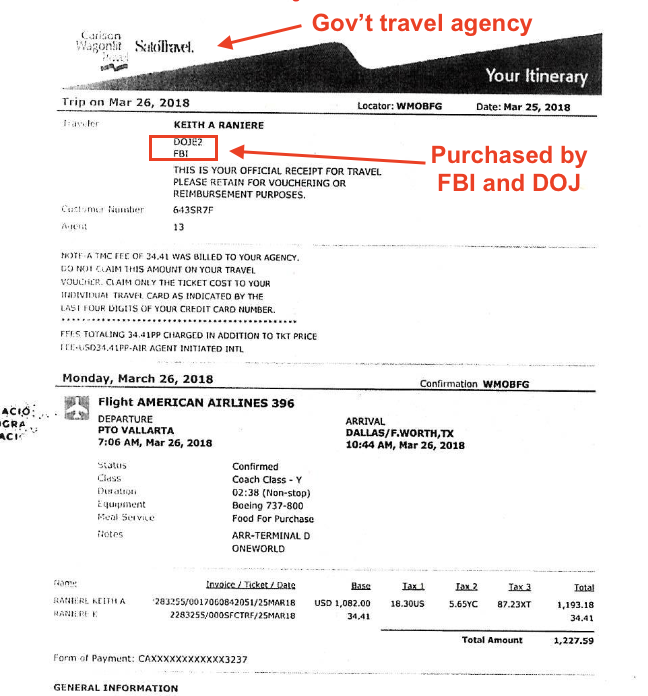
The receipt the prosecution did not disclose. CWTSato — the U.S. government travel agency — trip dated March 26, 2018. Payor: DOJ02 / FBI. Obtained by the defense from the Mexican immigration file three-plus years after trial. Click to enlarge. This wasn’t an informal abduction, which courts permit. This was two governments officially acting, bypassing the extradition treaty — the process under which the defense could have challenged the charges, the evidence, and the jurisdiction.
Walk through the proof → -
Mar 27, 2018 — An FBI agent pre-wrote entries in the “real-time” evidence log before the search began — naming what would be “found,” where, and in what order.
An FBI evidence log is supposed to be filled in live, as agents collect items — like a lab notebook. That’s what makes it trustworthy. Two former FBI search experts (43 years of combined FBI service) reviewed this log and concluded the opposite happened.
Before the search team arrived — and before there was an indictment — the FBI’s evidence logger had already written down key items that would be “found” and the order they’d be “found” in. The proof comes down to two facts on the log itself:
- The personnel list names an agent who wasn’t there — and leaves out one who was. The entries are in the logger’s handwriting, not in each agent’s. So the list was pre-filled.
- Page 3 of the log starts back at Item 1 — for a CD already logged as Item 9 on Page 1. Then crosses it out. The only way that happens: what is now Page 3 used to be Page 1, and got demoted when a new Page 1 (with the personnel list) was inserted in front of it.
Combined, the two facts prove the logger was pre-scripting what would be “found” before he set foot on the property.
And the item that got rewritten into the #1 slot?
- The Canon camera.
- The same camera the FBI later said they only realized was important “by accident,” nearly a year after the search. The lead prosecutor later contradicted that claim on HBO (see Finding 6).
- The same camera whose memory card seven forensic experts (plus an independent Newsweek expert) later concluded was falsified.
-
Mar 27, 2018 — FBI agents created evidence “scenes” using items of unknown origin.
In a post-trial report, two former FBI search experts — Retired FBI Senior Evidence Technician Kenneth DeNardo (23 years) and Retired FBI Assistant Special Agent in Charge Mark Daniel Bowling (20 years) — analyzed the FBI’s own search photos and identified the following:
- On an upstairs bookshelf, the entry photos (Photos 24, 26, 29, and Item 2’s evidence photo, Photo 34) show three devices on the bottom shelf. Nothing else.
- Later photos (72 and 73, Items 36 and 37) show the same spot — verifiable from the wall brackets and the edge of the desk — but rearranged:
- Only one device on the shelf in each.
- Around it: two books on sex trafficking (the central alleged charge), a caseless DVD labeled “STEM CELL,” an encased Rubik’s cube, and two CDs — as you can see in the photo of Item 37:
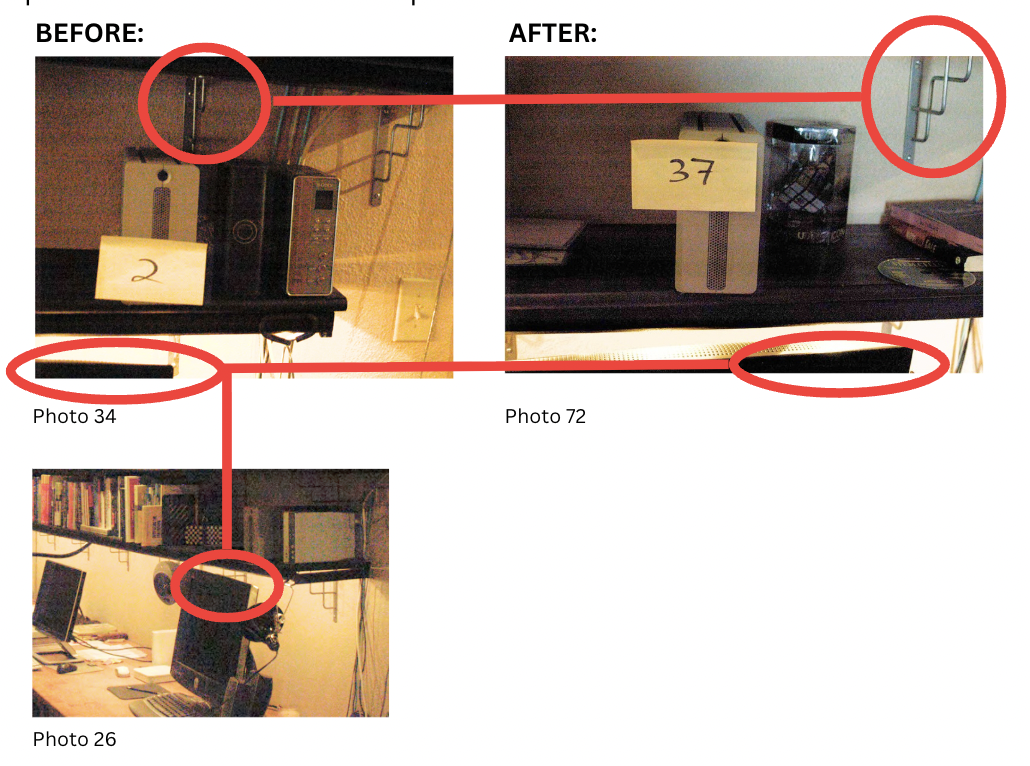
Same spot. Photos 26 and 34 (entry) versus Photo 72 (later) — verifiable from the wall brackets and the edge of the desk. 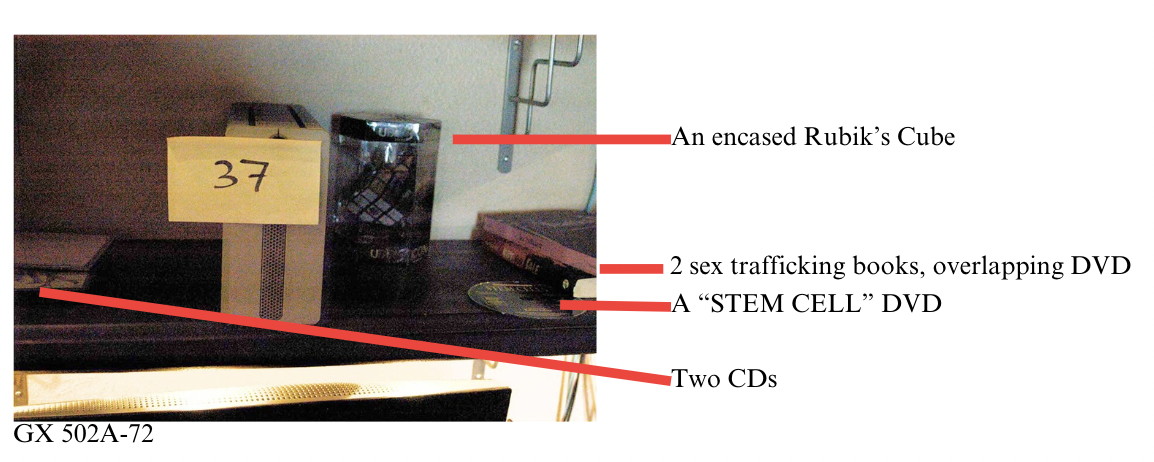
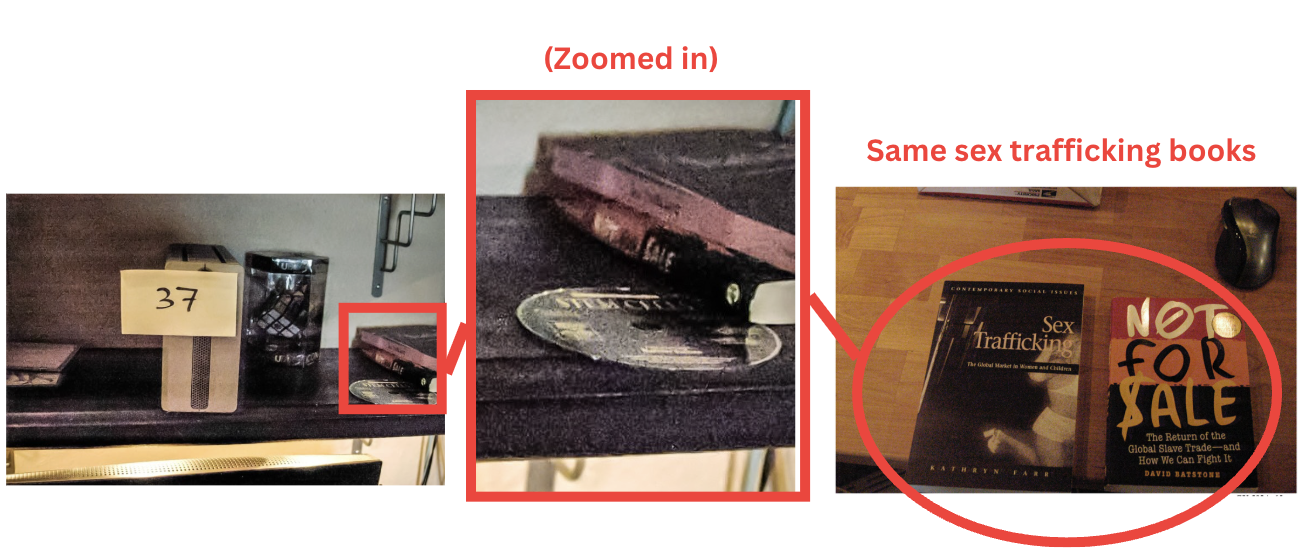
Same books. The two sex-trafficking books added to the bookshelf (Item 37) are the same two photographed up close on a desk in Photo 65 — never collected as evidence. - None of the added items appear in the entry photos or were photographed in place — no visual record of where they came from. None were collected as evidence.
- That is not moving things for clarity. That is set construction.
The jury saw these photographs as part of the search record. They were not told the scenes had been built. Several other examples are documented in the expert reports.
That is evidence creation. Before there was even an indictment.
Key evidence at trial came from this search — the camera, the memory card, the hard drive, the search photographs. The agents who built these scenes handled it afterward and testified to the jury about it. The contamination runs through every stage.
Walk through the proof → -
Sept 19, 2018 — An unnamed FBI technician secretly altered the camera’s memory card before it got to the forensics lab — and never signed the chain of custody.
FBI policy requires that an evidence device be officially copied at the FBI lab before any review. All review is done on the lab’s forensic file — never on the original. This protects the original from alteration.
On September 19, 2018 — months before the camera and card were delivered to the FBI lab:
- Lead case agent Michael Lever signed the camera out of evidence.
- He handed the memory card to an unidentified FBI “photograph technician.”
- The technician never signed the chain of custody.
- The technician accessed the card on a computer.
- Forensic evidence later showed the data was altered during that access. At trial, the government’s own examiner admitted the alteration under oath — but did not identify by whom.
The government concealed the technician’s existence for more than four years, disclosed only in a post-trial filing on July 21, 2023.
Walk through the proof → -
Feb 21, 2019 — The FBI swore the contraband photos were “accidentally” discovered — injecting what seven experts later concluded was planted evidence. The lead prosecutor admitted on HBO it was a targeted search.
Under the plain view doctrine, evidence outside a warrant generally only comes in if agents stumble onto it — not if they were searching for it.
Before trial:
- Lead case agent Michael Lever swears in an affidavit that agents accidentally discovered alleged contraband photos on a hard drive, allegedly taken by the camera discussed above.
- The “accidental” discovery is used to bring new charges, not included in the original search warrant.
- Prosecution opposes the motion to suppress this evidence, arguing the photos “in any event, were properly seized under the plain view doctrine.”
After trial:
- HBO airs a post-trial interview with former lead prosecutor Moira Kim Penza: “Once we knew about the picture taking, picture keeping, it was a matter of finding those.” That is not accidental discovery. That is a targeted search.
- Seven forensic experts and an independent Newsweek expert unanimously determined the photos were planted on the hard drive — disguised as files from a computer backup.
-
Feb 22, 2019 — The lead case agent checked out the hard drive. There’s no record it was returned.
- On February 22, 2019 — the day after the “accidental discovery” — lead case agent Michael Lever signed the hard drive out of the Evidence Control Room.
- The chain-of-custody record contains no entry for its return.
- This is the same chain-of-custody record the prosecution produced at trial in June 2019 — four months later — when the drive’s whereabouts still had no documented account.
The hard drive contained the disputed photos at the center of the case. There is no documented record of what happened with it thereafter.
Walk through the proof → -
Jun 11, 2019 — An FBI examiner secretly re-copied key evidence mid-trial. 37 new files appeared. The government concealed the re-copying for 5.5 years.
In digital forensics, the original device is supposed to be copied once. Investigators then work from that copy — never from the original. Going back to the original device and re-copying it is strictly prohibited by FBI policy, because each access to the original is an opportunity for the evidence to be altered or destroyed.
- FBI Examiner Stephen Flatley created the original forensic copy of the memory card.
- With four days left in the six-week trial, Examiner Brian Booth was substituted for Flatley, on the stated basis that Flatley was in Ghana (see Finding 9 — that claim has since been contradicted by Ghana’s own immigration records).
- Booth did not use Flatley’s forensic copy, though it was available and functional.
- Instead, on June 11, 2019, Booth went back to the original device and created a second forensic copy, which is prohibited.
- Booth produced a new report from that second copy. It listed 37 additional files that were not on Flatley’s original report.
- The new report was presented in court as a second report — not as a report derived from a prohibited re-copying of the original device.
- On June 13, 2019, AUSA Tanya Hajjar told the court: “he [Booth] never said I was the one who imaged the devices.” Booth had imaged the device two days earlier.
- Seven forensic experts have since concluded that at least 28 of the 37 added files were tampered with, and at least 20 were planted.
- The government concealed the existence of the second copying for more than 5.5 years — admitting it only on appeal, in response to a new-trial motion.
-
Jun 13, 2019 — Prosecutors told the court the original FBI examiner couldn’t testify because he was in Ghana. Ghana’s records say he wasn’t.
- Stephen Flatley was the original FBI forensic examiner who analyzed the camera and memory card – months after the card had been secretly altered by the FBI technician (see Finding 5).
- Five weeks into the six-week trial, Brian Booth was substituted for Flatley to testify about that device.
- AUSA Moira Kim Penza told the court: “CART Analyst Flatley is in Africa right now.” Booth testified: “Stephen Flatley is out on assignment in Ghana. So he’s not able to be here because he’s on operation.”
- Ghana Immigration Service records, obtained post-trial by the defense, show Flatley was in Ghana in 2018 — but not during the trial in 2019, and not afterward.
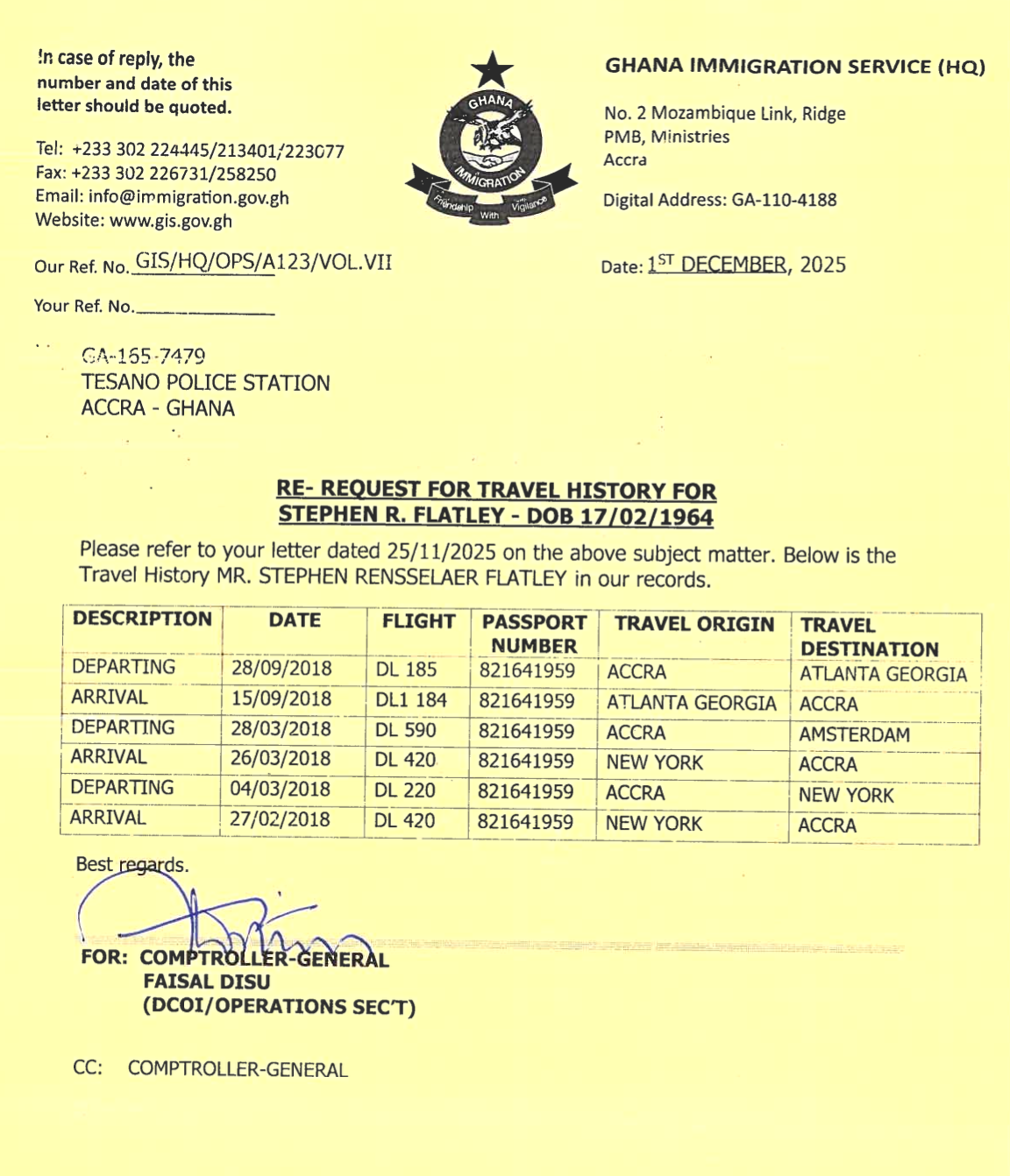
Ghana Immigration Service letter (notarized). Flatley’s last departure from Ghana was September 28, 2018 — more than eight months before trial. No entries during the trial. No entries since. Click to enlarge. - The false Ghana claim was used to justify Booth’s substitution — and to authorize Booth to re-examine the evidence. During that re-examination, Booth created the secret second forensic copy of the memory card (see Finding 8).
-
2023–2025 — A hearing on evidence-tampering was blocked by an FBI report with no date and no cited evidence.
Seven forensic experts (four former FBI) concluded the digital evidence had been falsified. The defense moved for an evidentiary hearing. Three actors handled what came next.
The Forensic Examiner
David Loveall II. In a separate federal prosecution, Loveall’s signed expert notice described him as having “more than two decades with the FBI . . . hundreds of digital forensic examinations . . . Adjunct Professor at George Mason University . . . teaching various courses including Advanced Computer Forensics,” and a recipient of “the FBI Director’s Award for Outstanding Technical Advancement, the Presidential Early Career Award for Scientists and Engineers . . . , and the Intelligence Community Seal Medallion.”
Required to: date the report, cite supporting evidence, disclose hash values (digital fingerprints).
Did: none of the three. The forensic equivalent of a DNA analyst concluding “the blood matched” without identifying the sample, the markers compared, or the testing method.
The Prosecutor
AUSA Tanya Hajjar — lead prosecutor. Worked the government’s response to the falsification claim over a thirteen-month period. Loveall was her sole forensic rebuttal to seven experts — four of them former FBI. She cited him five times. Quoted him three times.
Required to: submit dated declarations to bind statements to penalty of perjury (28 U.S.C. § 1746).
Did: never asked Loveall to date his report.
The Courts
The Eastern District of New York and the Second Circuit Court of Appeals.
Required to: hold an evidentiary hearing when material forensic conclusions rest on untested paper.
Did: denied the hearing. No Loveall testimony. No cross-examination. Affirmed on appeal — also on Loveall.
The hearing that would have surfaced whether the digital evidence was falsified was killed by a document that, by the rules of its own discipline, could not have been admitted at trial.
A date is basic. Cited evidence is basic. A hearing is basic. None of them happened.
Walk through the proof →
And — across these ten findings, the camera and memory card (the central piece of evidence) followed an irregular journey from search to trial.
Here’s what happened with one piece of evidence — the government’s federal jurisdictional hook, and what prosecutors called the “heart” of their case:
-
01
March 27, 2018
At the search, the camera was never visible in any search photograph. First shot: under a desk, not visible. Second shot (“for clarity”): on top of the desk, still not visible.
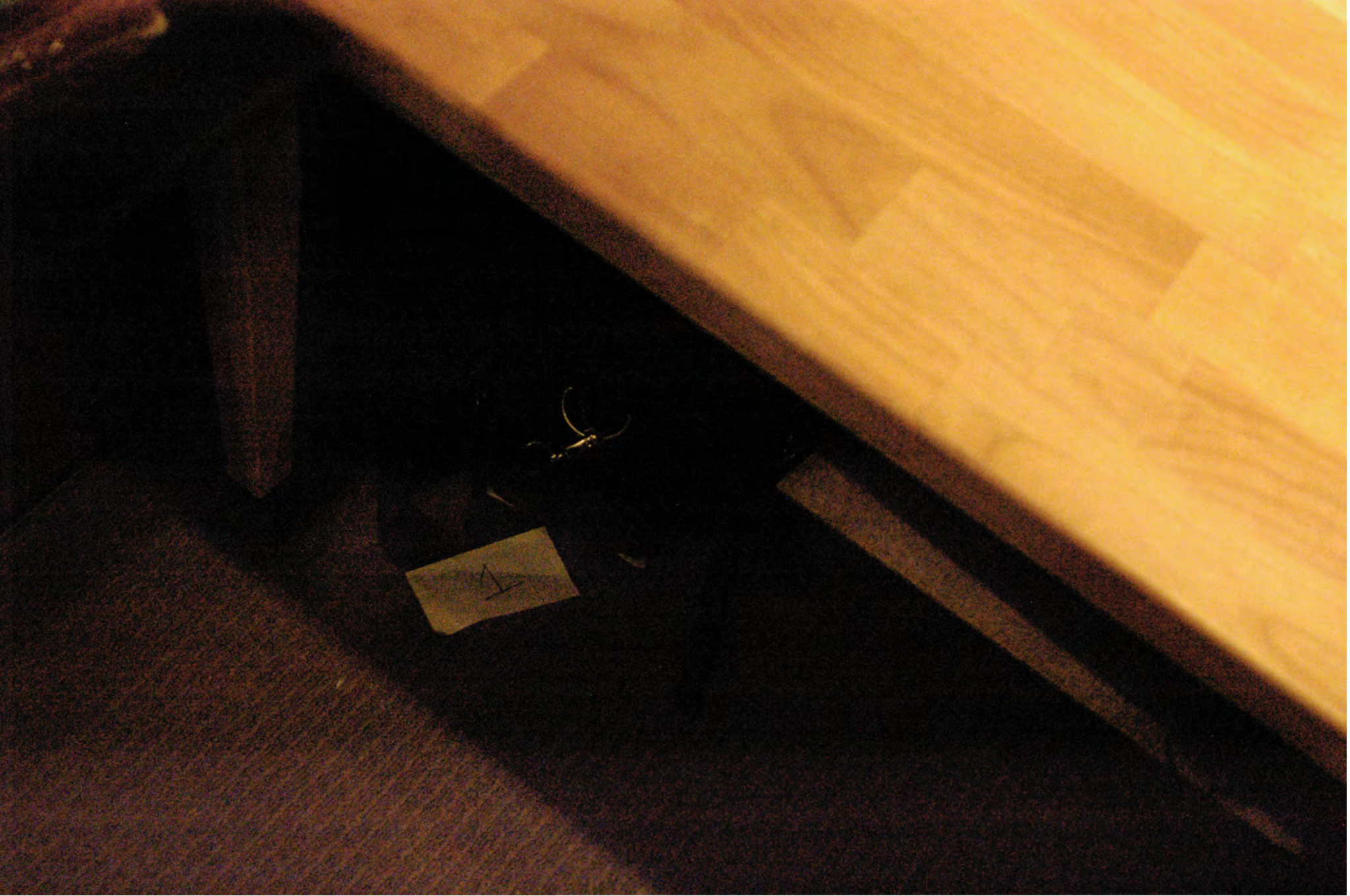
First photo: Item 1 placed under the desk. The camera itself is not visible. 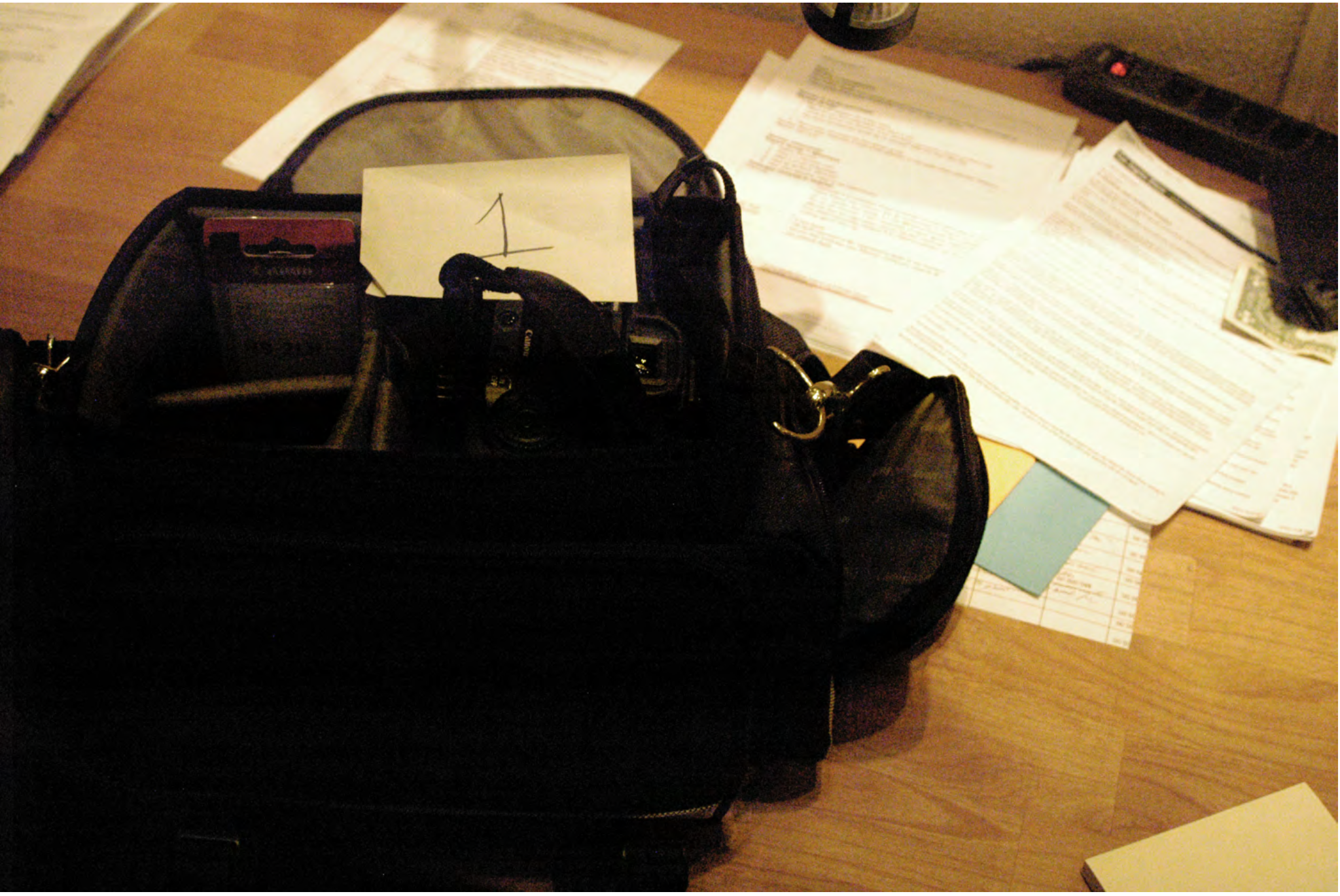
Second photo, the “clarity” shot: Item 1 moved onto the desk. The camera is still not visible inside the bag. -
02
July 10–27, 2018
Seventeen days of prohibited access. SA Meagan Rees checked the camera out for 17 days, before any official FBI lab copy had been made. The chain of custody is silent on what she did with it. Every other device from the property remained at Evidence Control during this period.
-
03
August 8, 2018
Lever delivered every other device from the property to the FBI lab — except the camera and memory card. (See the CART note in the F5 proof drawer →)
-
04
September 19, 2018
Lever signed the camera out and handed the memory card to an unidentified FBI “photograph technician” who never signed the chain of custody. The data on the card was altered during that access. (See Finding 5.)
-
05
February 21, 2019
For eleven months — despite multiple agents handling it — the camera sat in evidence without being treated as significant. Then Lever swore in an affidavit that contraband photos had been “accidentally” discovered on a hard drive — traced to this camera. (See Finding 6.) The very next day, the FBI lab finally copied the camera and memory card.
-
06
June 10, 2019
Agent Christopher Mills handed the camera and memory card to Booth in an unsealed cellphone bag, breaching evidence-handling protocol.
-
07
June 11, 2019
Four days before trial ended, at Lever’s request, Booth secretly created a second forensic copy. It contained 37 files not in the original. (See Finding 8.) The secret second copy was concealed for 5.5 years — and the government has refused to produce it.
Recurring Actors, Every Stage: Ten Verifiable Findings
The same ten findings (above), mapped to the people and stages involved. Click any column to jump to that finding.
| Capture | Search | Evidence Handling | Forensics, Trial & Beyond | |||||||
|---|---|---|---|---|---|---|---|---|---|---|
| F1Sealed Leak | F2Mexico Op | F3Pre-Scripted | F4Staged Scenes | F5Card Altered | F6Targeted Find | F7Drive Vanished | F8Second Copy | F9Ghana Alibi | F10Blocked Hearing | |
|
MP
|
||||||||||
|
TH
|
||||||||||
|
ML
|
||||||||||
|
BB
|
||||||||||
|
TS
|
||||||||||
|
DL
|
||||||||||
|
EM
|
||||||||||
|
CM
|
||||||||||
|
TM
|
||||||||||
|
??
|
||||||||||
red dot = a documented role in that finding